
The Trainer
Welcome to the Trainer!
The goal of the following lines is to explain what the Trainer is, how it works, and the philosophy behind its design.
Take a few minutes to go through this guide: it will give you all the keys to get the most out of your learning and understand the logic behind the exercises.
🖥️Tips for playing
To start, we don't recommend using Safari, as the Trainer generally works better on Chrome or Firefox.
The Trainer is available on mobile, but the experience is much better on a computer screen.
🎯Trainer Objective
In one word, our Trainer was designed to help you memorize and apply your preflop ranges as efficiently as possible.
Unlike traditional Trainers that give you random situations, we've designed a more educational system.
That's why we built a chapter-based progression system.
You start with the most frequent and impactful situations in the first chapters, and then move on to more specific or less common spots as you progress.
⚖️Vs Fish & vs Reg
Just like Charts, the Trainer integrates both complementary approaches of modern Spin & Go strategy:
- GTO Charts (vs Reg): the theoretical reference.
- Exploitative Ranges (vs Fish): the strategic deviations designed to exploit the tendencies of the recreational field.
You'll see that each chapter focuses separately on one of these two approaches.
You can also create custom Ranges in the Range Library. They will be automatically used in the Trainer if you select them (selection is done in the bottom-right panel on the Range Library page, separately for each situation).
🧮How Does XP Work?
Each correct answer gives you 10 XP. Each wrong answer makes you lose 10 XP.
Mix sessions (which combine multiple stacks) give you 30% more XP.
Hardcore mode gives you 50% more XP, but also makes you lose 50% more on wrong answers.
To reward consistency, your total XP is multiplied by the square root of your streak, your number of consecutive active days (your "flames"). Each day without playing costs you 3 flames.
The XP system mainly exists to add fun and motivation to your learning experience. Leveling up doesn't give you any direct advantage, but it allows you to track your progress, unlock new badges, and maybe even become the first to reach the final level…
🤔Not All-in or All-in?
In the first two chapters of the Trainer, since they are relatively complex, we simplified the decision.
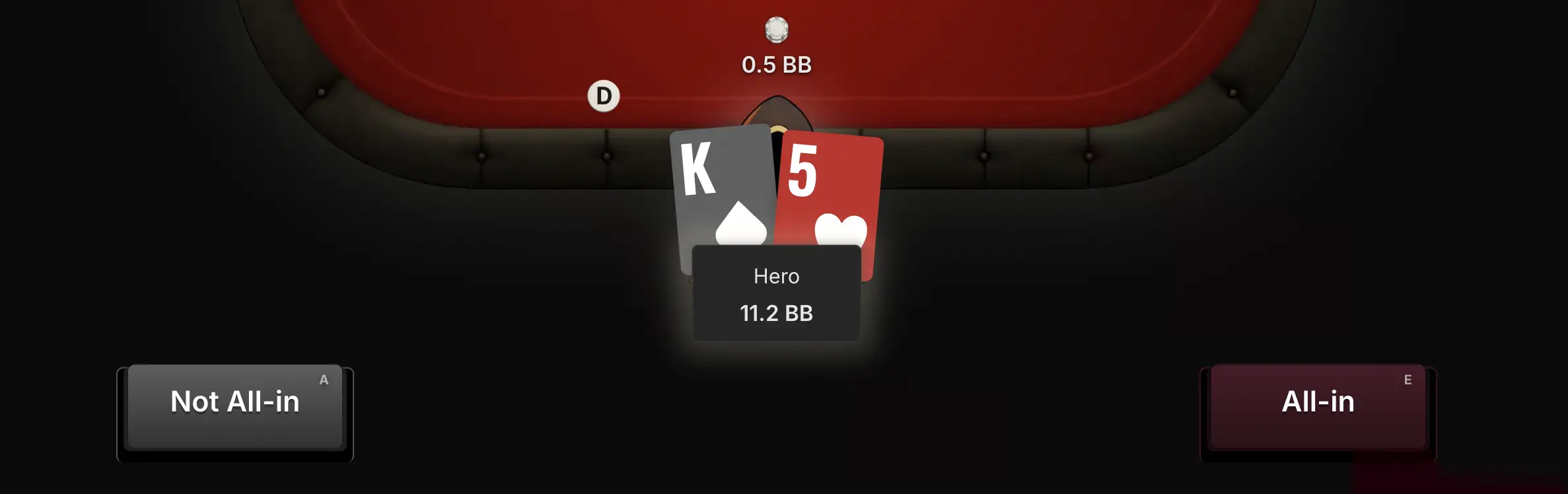
Not All-in groups, as the name suggests, all non all-in actions: Fold, Check and Raise.
All-in means... All-in.
Chapters 3 and 4 are the same as chapters 1 and 2, but this time instead of Not All-in you will have to choose between Fold, Check or Raise.
❓The Push (and Call) charts
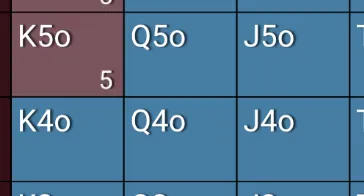
You may have come across these unique charts with numbers in the bottom-right corner of each cell during the first chapters of the Trainer. Don't worry, we'll explain how they work.
These are Push or Call charts.
The number in the bottom-right corner of the cell indicates the blind level from which you should push the hand (or call if it is a call chart).
This number is always included. For example, with 17 bb, you should push (or call if it is a call chart) starting at 17 bb, inclusive.
Note on colors
Some intermediate colors in the Push (or Call) charts do not have a special meaning: they simply help you visualize how charts evolve as stacks decrease.
Basically, the lighter the color, the more the hand becomes a push (or a call...) at small stacks.
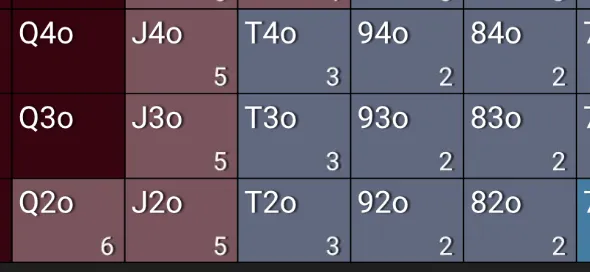
Note that to make memorization easier, the minimum push/call thresholds are written in:
- 🔴 red for offsuited hands.
- 🔵 blue for suited hands.
These numbers are essential to memorize.
Concrete example, for the HU BB vs SB all-in range:
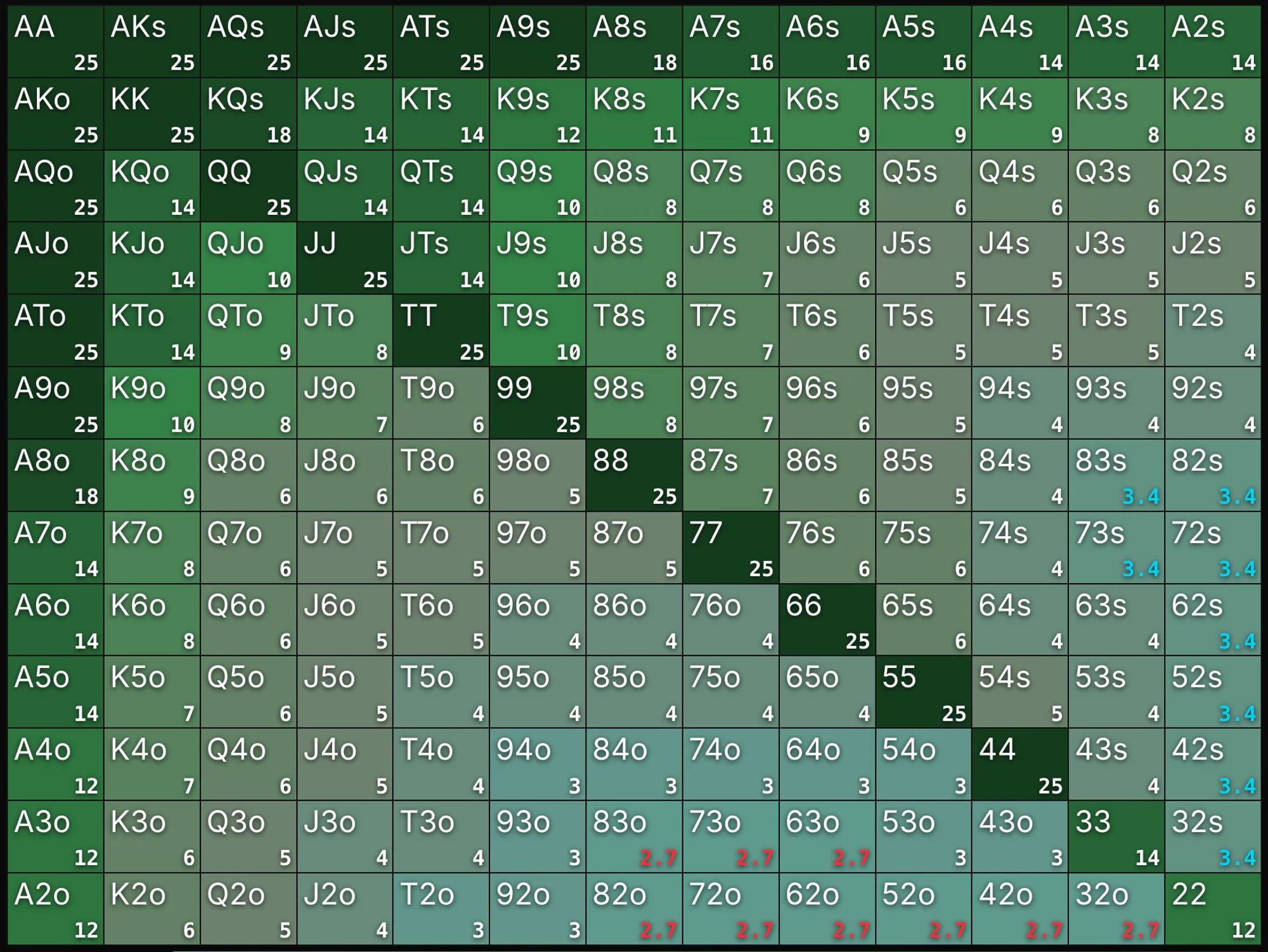
You can see that we can call: all offsuited hands below 2.7 bb (🔴) and all suited hands below 3.4 bb (🔵).
Lastly, you will sometimes encounter (rarely, don't worry) cells with intervals:
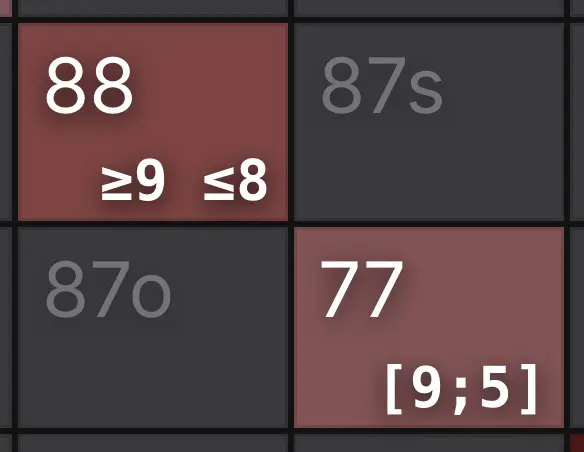
There are two types of intervals.
- Intervals of the [a;b] type: you should push (or call) only if your effective stack is within that interval.
- Intervals of the ≥a ≤b type: you should push (or call) only if your effective stack is greater than or equal to a, or less than or equal to b.
Yes, it's not always easy, but this will rarely happen and rest assured, this is not where you'll make 99.9% of your EV...
🚀Tips for Success
1. Master each chapter before moving on
Progressing too fast is rarely a good idea.
The goal isn't to finish all chapters in 24 hours, but to master your Charts over time. If, for example, Chapter 1 (one of the most important) takes you a month to learn, take that month. It's not a race, and every player goes through this sometimes long learning phase.

2. Work deeply on one blind level at a time
Only move on when you feel truly comfortable.
3. Regularly revisit previous chapters
It's a great way to review your knowledge and warm up before your grind sessions.
4. And most importantly, have fun!
Doing volume and grinding over the long term is essential to beat variance. To do that, enjoying learning and playing is key.
Take breaks when you start to feel tilted or tired, and set realistic goals (daily, weekly, or monthly). This makes your progress measurable and rewarding.
Alright, enough talking.
Happy learning.
And good luck at the tables!